

Did you know that 93% of all online experiences start with a search engine like Google? Here’s the big truth—without good content, even the best SEO tricks won’t work. That’s why it’s so important to understand how content marketing helps SEO and why the two must work together to make your website not just visible, but memorable.
Think about it: what’s the point of being on the first page of Google if your content doesn’t give people the answers they need? In fact, 72% of marketers say content marketing brings more engagement and leads. This clearly shows how content marketing helps SEO by making your site useful, relevant, and trusted.
At its heart, how content marketing helps SEO is simple—it gives Google valuable content to rank and gives readers what they are searching for. SEO sets the structure, but content is the voice that speaks to people. Blog posts, videos, and guides not only bring traffic, but also build trust and authority.
So, ask yourself: do you just want to “rank,” or do you want content that ranks, connects, and converts? Let’s explore how this powerful mix can boost your online success.
What Is SEO?
Search Engine Optimization (SEO) is the process of improving a website so it appears higher in search engine results like Google, Bing, or Yahoo. When someone types in a keyword related to your business, SEO helps your site show up more often and in better positions. The goal is simple: attract more visitors, increase visibility, and ultimately get more conversions.
At its core, SEO involves three main elements:
- On-page SEO – This is everything you do on your website, such as using the right keywords, optimizing titles and headings, writing meta descriptions, and improving site speed.
- Off-page SEO – This focuses on building trust and authority outside of your website. For example, getting backlinks from other websites, social media signals, and brand mentions.
- Technical SEO – This ensures that search engines can crawl and index your site easily. It involves fixing errors, improving mobile responsiveness, enhancing site speed, and having a clean site structure.
Think of SEO as the foundation of your online home. Without it, even the best-looking house won’t be found on the map. That’s why SEO is essential for any online business—it makes sure you’re visible when your potential customers are searching.
What is content marketing?
The benefits of content marketing for SEO are best understood through its core strategy: creating and sharing valuable, relevant, and consistent content to attract and engage a target audience. Instead of directly pitching products or services, content marketing focuses on building trust and relationships by giving people useful information.
This content can take many forms, including:
- Blog posts
- Articles
- Videos
- Podcasts
- Infographics
- E-books
- Social media posts
The goal is to educate, inform, or entertain your audience while guiding them naturally toward your brand. For example, if you run a fitness brand, content marketing could mean publishing workout guides, healthy recipes, and motivational stories that inspire people to live healthier lives.
In short, content marketing is about storytelling and value creation. It answers your audience’s questions and solves their problems, making them more likely to choose your brand over competitors.
Driving Organic Traffic
One of the biggest benefits of content marketing is its ability to drive organic (free) traffic. When you consistently publish high-quality content, people find it through search engines and social media. Over time, this traffic grows without you having to spend money on ads.
For example, let’s say you write an article titled “10 Easy Home Workouts for Beginners.” People searching for “easy workouts at home” might find your post, visit your site, and start exploring your brand. With SEO-friendly content, this blog could continue driving traffic for months or even years after it’s published.
The more content you create, the more opportunities you have to rank for multiple keywords. And the more keywords you rank for, the more chances you have of attracting potential customers.
Building Authority and Trust
Content marketing helps position you as an expert in your field. When you share valuable insights, guides, and tips, people start seeing your brand as trustworthy and reliable. Over time, this builds authority and shows How Content Marketing Helps SEO by strengthening your online presence.
Imagine you’re a financial advisor. If you regularly post content about budgeting tips, investment strategies, and retirement planning, people will start trusting your advice. When they need professional help, they’re more likely to contact you than someone who hasn’t shared any useful information.
Trust is a key factor in business success, and content marketing provides a way to earn it naturally. People prefer buying from brands they feel connected to, and content marketing helps build that connection.
Improves User Experience
A good user experience (UX) is vital for keeping visitors engaged. Content marketing plays a big role here because it delivers helpful, easy-to-digest information that users actually want.
For example:
- A clear blog structure with headings and bullet points makes content easy to read.
- Adding images and videos keeps readers interested.
- Writing guides and tutorials helps users solve their problems quickly.
Google also rewards websites that provide a great user experience. If people stay longer on your site, engage with your content, and don’t leave immediately (low bounce rate), search engines will see your website as valuable and rank it higher.
So, not only does content marketing keep your audience happy, but it also boosts your SEO efforts by making your site more appealing to search engines.
Content marketing vs SEO
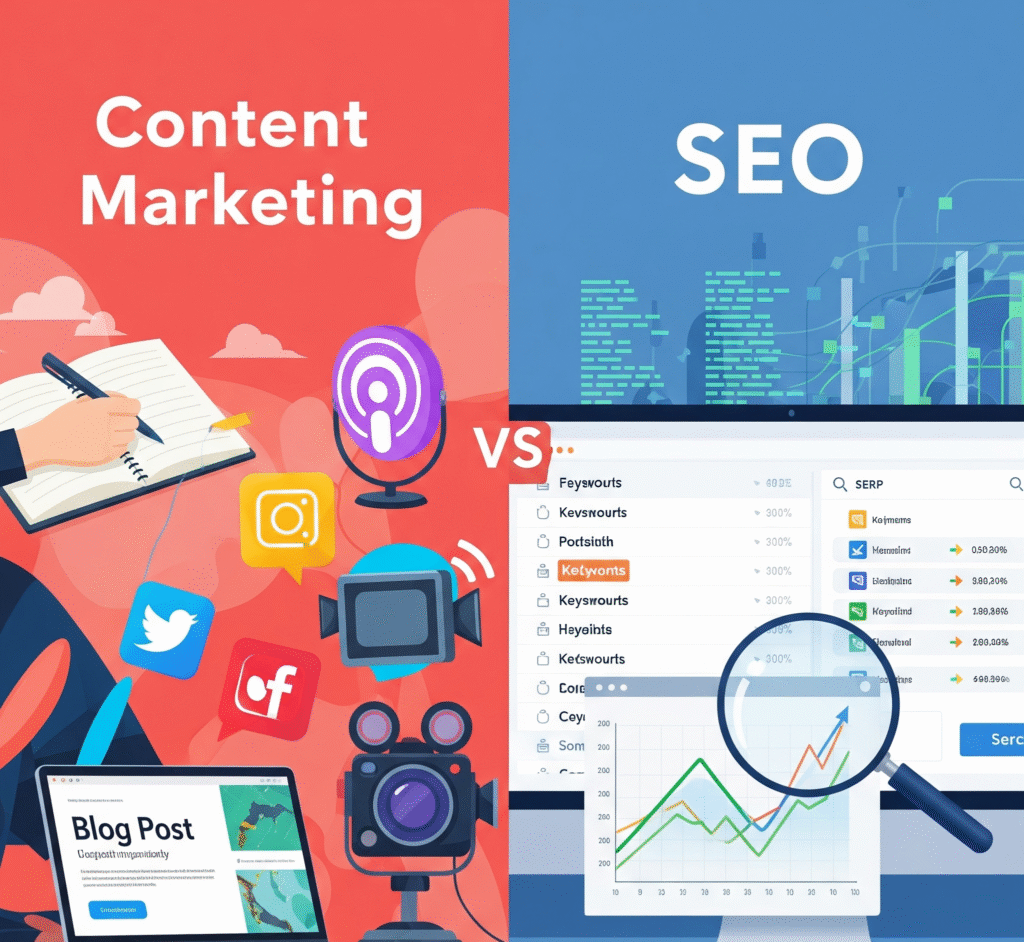
It’s a common mistake to think of content marketing and SEO as competing strategies. In reality, they are different but entirely dependent on one another. They form a powerful partnership where one provides the substance and the other provides the reach. To put it simply, content marketing is the “what,” and SEO is the “how.”
Content marketing is the strategy of creating real value through blog posts, videos, articles, and infographics that educate and engage your audience. It highlights the human side of marketing by building trust and nurturing a community around your brand. The focus is on understanding your audience’s needs and delivering information that solves their problems, answers their questions, or entertains them. How Content Marketing Helps SEO becomes clear when you realize that without content, your website is just a static page with little to offer visitors.
On the other hand, SEO is the process of making that valuable content visible to search engines. It involves the technical side of things, like keyword research, optimizing your site’s speed, building quality backlinks, and ensuring your website is structured in a way that Google can easily understand. SEO’s job is to ensure that when someone searches for a topic you’ve covered, your content shows up high in the search results.
Think of it like this: content marketing is about writing a great book—one that is so well-written, informative, and compelling that people would want to read it. SEO is about making sure that book is on the front shelf of the biggest bookstore in the world, with a clear label, an eye-catching cover, and a perfect location so people can easily find it. You can write a masterpiece, but without a good way for people to discover it, nobody will read it. Conversely, you can have a perfect shelf and location, but if the book you put on it is poorly written and unhelpful, no one will bother to buy it. The two strategies must work together seamlessly to achieve success.
The importance of SEO in content marketing
O and content marketing go hand in hand. Without SEO, your content may not get discovered. Without content marketing, SEO has nothing to optimize.
- It Tells You What to Create: SEO starts with keyword research. This process tells you what questions your audience is asking and what topics they are interested in. This research is the most important part of your content plan. It ensures you are creating content that people are actually searching for.
- It Gives You a Road Map: SEO helps you structure your content. This includes using proper headings (H1, H2, etc.), using keywords naturally, and adding internal links to other pages on your site. This structure makes your content easy for both humans and search engines to read and understand.
- It’s the Long-Term Game: While social media and paid ads can give you a quick burst of traffic, SEO is about building a sustainable, long-term source of visitors. The effort you put into optimizing a piece of content today can bring you free traffic for years to come.
What is the difference between SEO and content marketing?
The key difference between SEO and content marketing lies in their primary focus, yet they are deeply interconnected. To put it simply, SEO is a technical and strategic discipline, while content marketing is a creative one. They are not interchangeable, but rather two halves of a complete and effective digital strategy.
SEO is about visibility. Its main goal is to make your website more appealing to search engines so it ranks higher in search results. This involves a lot of behind-the-scenes work, like finding the best keywords, improving your website’s technical performance so it loads quickly, and building links from other reputable websites. Think of SEO as the engineering side of your online presence—it’s what makes sure your website is structurally sound and easy for search engines to find and understand. Without a good SEO strategy, even the best content might never get seen.
Content marketing is about value. The main goal of content marketing is to create and distribute material that attracts and engages your target audience. This is the creative side of the process—writing helpful blog posts, producing engaging videos, designing informative infographics, and sharing them across different platforms. Content marketing builds trust with your audience and positions your brand as an authority in your field. It answers their questions, provides real value, and encourages them to become loyal customers. How Content Marketing Helps SEO is evident when you realize that a website with great content but no SEO is like a brilliant book hidden in a dusty attic—valuable, but unseen.
They are meant to work together as a single, powerful strategy. A website with great SEO but no good content will fail because users will quickly leave after finding nothing of value. A website with amazing content but no SEO will fail because no one will ever find it in the first place. You need both to succeed online: the value provided by content marketing and the visibility provided by SEO.
How content marketing supports SEO
Let’s quickly recap the main ways content marketing helps your SEO:
- It Creates the Content to be Optimized: Content is the canvas for SEO. It gives you something to optimize.
- It Earns Backlinks: High-quality content naturally attracts links from other websites, which is a key ranking factor.
- It Improves User Signals: Engaging content keeps visitors on your site longer and encourages them to explore, signaling to search engines that your site is a good result.
- It Allows for Keyword Targeting: Content allows you to create specific pages for different keywords and topics, expanding your reach.
- It Boosts Social Signals: Shareable content gets spread on social media, increasing its visibility and opportunities for backlinks.
How do you combine SEO and content marketing?
To truly succeed, you must think of them as one unified strategy. Here is a simple step-by-step process:
- Start with Keyword Research: Use tools like Google Keyword Planner or SEMrush to find out what your audience is searching for. Look for keywords that are relevant to your business and have a good search volume.
- Plan Your Content Around Those Keywords: Create a content calendar. For each piece of content, identify the main keyword and related topics you want to cover.
- Create High-Quality Content: Write content that is not only well-optimized for search engines but also genuinely useful and engaging for your human audience. Answer their questions, provide real value, and use clear, easy-to-read language.
- Optimize as You Go: As you create your content, naturally include your target keywords in the title, headings, and body. Write a compelling meta description and use descriptive image alt text.
- Build Links and Promote: Once your content is live, share it on social media. Reach out to other websites in your industry and ask them to link to your content if it adds value for their readers.
- Measure and Adjust: Use tools like Google Analytics to track how your content is performing. See which articles are getting the most traffic, how long people are staying on the page, and which keywords are bringing in visitors. Use this data to improve your future content.
How much does content marketing and SEO cost?
The cost can vary a lot depending on your needs, but it’s important to see it as an investment, not an expense.
- For DIY (Do-It-Yourself): The cost is mostly your time and effort. You might pay for a few tools, which can range from $20 to $100+ per month.
- Hiring a Freelancer: A freelance content writer might charge you per article (e.g., $100 – $500 per blog post). A freelance SEO consultant might charge by the hour ($75 – $200+) or by a monthly retainer.
- Hiring an Agency: An agency will provide a full service and can be a significant investment. For small to medium-sized businesses, a combined content marketing and SEO service can cost anywhere from $2,000 to $10,000 or more per month, depending on the scope of work.
While the local SEO cost can seem high, remember that good SEO and content marketing provide a high return on investment (ROI) over the long term. Unlike paid ads that stop working when you stop paying, the organic traffic and authority you build through content marketing can continue to bring you business for years.
Do you need help growing your business with a limited budget?
At smarinsider.com we specialize in creating custom, affordable digital marketing strategies for small and medium-sized businesses. Whether you need a full-service plan or help with specific content and SEO tasks, we work with you to understand your goals and deliver a solution that fits your budget. We believe every business deserves a powerful online presence. Contact us today to learn how we can help you drive traffic, build authority, and achieve sustainable growth.
Conclusion
In the digital world, content marketing and SEO are inseparable partners. One provides the valuable information, and the other ensures that information is seen by the right people at the right time. By treating them as a single, cohesive strategy, you can build a powerful online presence that drives organic traffic, establishes your brand as an industry authority, and leads to sustainable, long-term growth. Don’t ask which one is more important; instead, ask how you can make them work together to achieve your business goals.
FAQ
Which of the following does content marketing help with SEO?
- Keyword Rankings: Content gives you a place to use keywords and phrases that your audience is searching for.
- Backlinks: Valuable content naturally earns links from other websites, which is one of the most important signals of authority for search engines.
- User Engagement: Engaging content keeps visitors on your site longer (increasing “dwell time”) and reduces the number of people who leave right away (“bounce rate”). Both of these are positive signals to search engines.
- Website Authority: Consistently publishing high-quality, expert content establishes your brand as a trusted source in your industry, which search engines reward with higher rankings.
- Organic Traffic: By targeting a wide range of topics and keywords, content marketing helps your site appear in more search results, driving more free traffic.
What content is best for SEO?
The best content for SEO is high-quality, useful, and original. This includes comprehensive guides, detailed tutorials, original research, and any content that directly and thoroughly answers a user’s question.
How does content marketing help?
Content marketing provides the substance that SEO needs. It creates the pages and resources that can be optimized for keywords, shared on social media, and linked to by other websites. Without content, there is nothing for SEO to work on.
Does more content help SEO?
Yes, but only if the content is high-quality. Publishing a consistent stream of excellent, valuable articles helps you rank for more keywords and signals to search engines that your site is active and trustworthy. Low-quality content, however, can harm your rankings.
What is the most important factor in SEO?
The most important factor in modern SEO is content quality and relevance. Google’s goal is to provide the best possible answer to a user’s search, and that answer is your content. Without great content, other SEO efforts like backlinks and site speed will have little impact.